 Batteries
 Inverters
 Solar Panels
 Solar Kits
 Mounting & Hardware
 Components & Wiring


Short answer: Peak sun hours are the number of hours in a day that would add up to your total sunlight if the sun shone at a full 1,000 watts per square meter. Five peak sun hours equals 5 kWh of sunlight per square meter. Multiply your panel wattage by that number to estimate daily output before losses.
Key takeaways
- One peak sun hour is one hour of sunlight at 1,000 W per square meter, the same level panels are rated at.
- Peak sun hours are not the same as daylight hours. A 12 hour summer day may only deliver a handful of peak sun hours.
- Quick estimate: panel watts × peak sun hours = watt hours per day, before real world losses.
- Your number changes with location, season, weather and how the panels are tilted and aimed.
- Size an off grid system for your worst month, not your sunniest one.
What are peak sun hours?
Peak sun hours are a simple way to describe how much solar energy lands on a spot in a day. Sunlight is weak at dawn, strong around midday and fades again in the evening. Instead of tracking that whole curve, you squeeze it into the number of hours it would take at full strength.
PVEducation explains that peak sun hours are numerically equal to the average daily insolation in kWh per square meter. So a place that receives 5 kWh/m² on an average day has 5 peak sun hours. Same number, two names.
Why 1,000 W/m²? That’s the light level solar panels are rated at. When a panel is labeled 400W, that rating assumes 1,000 W/m² hitting it under standard test conditions. That’s what makes the math so handy.
Are peak sun hours the same as hours of daylight?
No, and this is the most common mix up. Daylight hours count every minute the sun is up. Peak sun hours only count the energy, converted to full strength hours.
A long June day might have 14 or 15 hours of light, but the early morning and late evening sun is low and weak. Those hours add very little. That’s why even a sunny summer location shows far fewer peak sun hours than daylight hours.
How do peak sun hours affect solar panel output?
They set the ceiling on what your panels can make in a day. The basic formula is easy:
Panel watts × peak sun hours = daily watt hours (before losses)
Here’s what that looks like for a single 400W panel. These are round number examples for the math, not a forecast for any location.
| Peak sun hours | 400W panel, daily output before losses | 10 panel array (4 kW), before losses |
|---|---|---|
| 3 | 1.2 kWh | 12 kWh |
| 4 | 1.6 kWh | 16 kWh |
| 5 | 2.0 kWh | 20 kWh |
| 6 | 2.4 kWh | 24 kWh |
Real systems come in lower than this table. Heat, wiring, dust, shading and inverter conversion all take a slice. Your charge controller matters too. If you’re running a battery bank, our MPPT vs PWM charge controller guide explains why the controller type changes how much of that energy you actually keep.

What changes the number of peak sun hours you get?
Several things, and some you can control:
- Location. Latitude and local climate make a big difference. Sunny, dry regions usually see more than cloudy northern ones.
- Season. Winter days are shorter and the sun sits lower, so most places get fewer peak sun hours in winter than in summer.
- Weather. Clouds, haze and smoke cut the energy reaching your panels on any given day.
- Tilt and direction. Data is often reported on a flat, horizontal surface. Panels tilted toward the sun can catch more, which is why PVEducation notes you need to account for the module’s angle.
- Shade. Trees, chimneys and nearby buildings take away hours that the maps assume you have.
How do I find the peak sun hours for my location?
Use real solar resource data for your address. The free PVWatts calculator from the National Laboratory of the Rockies (formerly NREL) lets you enter a location, panel tilt and direction, then estimates monthly production from long term weather data. Solar resource maps and insolation tables give similar numbers as kWh/m² per day.
When you look these up, note the lowest month, not just the yearly average. That low number is what matters most if you plan to live off grid or rely on batteries through winter. Our solar calculator can help you rough out system size once you have your number.

How do I use peak sun hours to size a solar system?
Work backward from the energy you use. A simple version:
- Find your daily use in kWh. Your utility bill or a load list gives you this.
- Divide by your peak sun hours. 20 kWh a day ÷ 5 peak sun hours = 4 kW of panels, before losses.
- Add a cushion for losses. Real output is lower than the nameplate math, so size up or use a tool like PVWatts that builds losses in.
- Divide by panel wattage. 4,000W ÷ 400W panels = 10 panels before that cushion.
- Check your worst month. For off grid, run the numbers again with your lowest month of sun.
If you’re building an off grid setup, our guide on how to choose an off grid solar kit size walks through matching panels, batteries and inverter. For picking the panels themselves, see how to choose solar panels for a home, or browse our solar panels.
Ready to turn your sun hours into a panel count? See how many solar panels you need for your home, with worked examples.
Frequently asked questions
How many peak sun hours do I need for solar to be worth it?
There’s no single cutoff. Fewer peak sun hours means each panel makes less, so you need more panels for the same output. Solar can still work in cloudier places, it just takes a bigger array. Compare your local numbers against your energy use and system cost to see how the payback looks for you.
Do solar panels work on cloudy days?
Yes, but they make less. Clouds reduce the sunlight reaching the panels, so a cloudy day adds fewer peak sun hours than a clear one. That’s why monthly averages are more useful for planning than a single day, and why off grid systems are usually sized with extra panels or battery capacity for stretches of bad weather.
Is 4 peak sun hours good?
It’s a workable number for many systems. At 4 peak sun hours, a 400W panel makes about 1.6 kWh a day before losses. Sunnier places get more, cloudier places get less. What matters is how your number compares with your daily energy use and how many panels you have room for.
Should I use my yearly average or winter peak sun hours?
For a grid tied system, the yearly average is fine because the grid covers short months. For off grid or battery backup you depend on through winter, use your lowest month. Sizing to the average can leave you short on energy right when days are shortest.
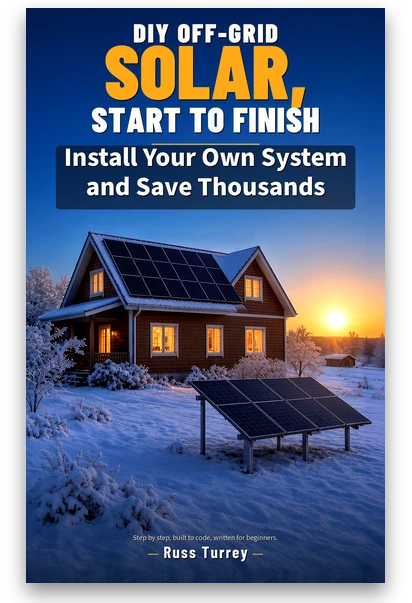
New book:
DIY Off-Grid Solar, Start to Finish.
Off-grid only, written for beginners who want to do the work carefully.
Kindle, $4.99 through New Year's: instant digital download. Paperback, $29.99: 370+ pages, 120+ diagrams, full-size 8.5 x 11 printed copy.