 Batteries
 Inverters
 Solar Panels
 Solar Kits
 Mounting & Hardware
 Components & Wiring


Short answer: Asking "how many solar panels do I need?" Divide your daily kWh use by your local peak sun hours, then by a loss factor of about 0.8 to get array size in kW. Divide that by one panel’s wattage. A home using 30 kWh a day with 5 sun hours needs about 17 panels at 450W.
Key takeaways
- Start with your own electric bills. Your yearly kWh total is the most important number.
- Peak sun hours where you live change the answer more than almost anything else.
- Bigger panels mean fewer panels, but the total kW of the array stays about the same.
- Off-grid systems should be sized for your worst month, not your average one.
- Check roof space and your inverter’s PV input limits before you settle on a panel count.
How many solar panels do I need for my house?
It depends on three things: how much electricity you use, how much sun you get, and the wattage of the panels you buy. Once you know those, the math takes about two minutes.
For a rough reference point, the U.S. Energy Information Administration reports that the average U.S. residential customer bought 10,791 kWh of electricity in 2022, about 899 kWh a month. That works out to roughly 30 kWh a day. Your home could be well above or below that, so use your own numbers whenever you can.
How do you calculate the number of solar panels you need?
Use this simple formula. It gets you close enough to shop, and you can refine it later with a production estimate for your exact address.
- Find your daily use. Add up 12 months of kWh from your bills and divide by 365.
- Find your peak sun hours. This is the average number of hours per day of full strength sun at your location.
- Divide daily kWh by sun hours. The result is the array size in kW you’d need in a perfect world.
- Allow for losses. Divide by 0.8. That’s a planning cushion we use for wiring, heat, dust, inverter losses and shade, not a fixed rule.
- Divide by panel size. Convert the array to watts and divide by one panel’s rated watts. Round up.
Here’s the 30 kWh example worked through: 30 ÷ 5 sun hours = 6 kW. Then 6 ÷ 0.8 = 7.5 kW. And 7,500W ÷ 450W = 16.7, so you’d plan on 17 panels.
If you’d rather skip the arithmetic, our solar calculator runs the same kind of numbers for you.
How do peak sun hours change the panel count?
A lot. The same house needs noticeably more panels in a cloudy region than in a sunny one, because each panel makes less energy per day.
The table below uses the same 30 kWh a day and the same 0.8 loss factor. Only the sun hours and panel size change.
| Peak sun hours | Array size needed | 400W panels | 450W panels |
|---|---|---|---|
| 4 | 9.4 kW | 24 | 21 |
| 5 | 7.5 kW | 19 | 17 |
| 6 | 6.3 kW | 16 | 14 |
Not sure what your number is? Our guide to peak sun hours explains what the figure means and how to look it up. For an address level estimate, NLR’s free PVWatts calculator (formerly hosted by NREL) models production from local weather data.

Does panel wattage matter?
It changes how many panels you buy, but not how much energy the system makes. A 7.5 kW array produces about the same whether it’s built from 400W or 450W panels.
Higher wattage panels mean fewer pieces to mount, fewer connections and fewer rail sections. They’re also physically bigger and heavier. The SunGold SGN-450-BDG5, for example, measures 69.37 by 44.65 inches and weighs 53.35 pounds according to its datasheet. If you’re comparing models, our guide on how to read a solar panel spec sheet shows which numbers matter.
How much roof space do I need for my solar panels?
Multiply the panel count by the area of one panel, then leave room for spacing and any setbacks your local code requires. Panel area alone is the minimum, not the full answer.
Using the SGN-450-BDG5 size above, each panel covers about 21.5 square feet. Seventeen of them take up roughly 366 square feet of panel surface before you account for gaps, edges and walkways.
If the roof can’t fit the full count, you have a few options:
- Use higher wattage panels so fewer fit the same job.
- Put part of the array on a ground or pole mount.
- Cover part of your use with solar and buy the rest from the grid.
How many panels do I need for an off-grid system?
Usually more than a grid-tied home with the same yearly use. Off-grid, there’s no utility to fill the gaps, so you size for the shortest, darkest days you expect to live through.
That means using your winter sun hours in the formula, not the yearly average. It also means pairing the panels with enough battery storage to ride through cloudy stretches. Our walkthrough on how to choose an off-grid solar kit size covers that side of the plan.
Complete kits can make this easier, since the panel count is already matched to the inverter and battery. One example is the SunGold SGR-12K20E off-grid kit with twelve 450W panels.
What else limits how many panels I can use?
Your inverter or charge controller. Every unit has a maximum PV input in watts, a maximum input voltage and a set number of MPPT inputs. The panel count has to fit inside those limits, string by string.
Budget matters too. Many people start with what their roof and wallet allow and add more later. If you go that route, choose an inverter with room to grow, and keep the datasheet of the panel you bought so new panels can be matched closely.
When you’re ready to compare options, browse our solar panels by wattage and type.
Frequently asked questions
How many solar panels does it take to power a house?
For an average U.S. home using about 30 kWh a day, it’s often somewhere around 14 to 24 panels, depending on sun hours and panel wattage. A sunny location with 450W panels lands near the low end. A cloudier spot with 400W panels lands near the high end. Your own bills give the real answer.
How many solar panels do I need for 1,000 kWh a month?
That’s about 33 kWh a day. With 5 peak sun hours and a 0.8 loss factor, you’d need about 8.3 kW of panels. That works out to 19 panels at 450W or 21 panels at 400W. Fewer sun hours push the count up, and more sun hours bring it down.
Is it better to have more small panels or fewer big panels?
Total array size is what sets production, so either can work. Fewer large panels mean less mounting hardware and fewer connections. Smaller panels can fit odd roof sections better and are easier to carry. Pick the size that fits your roof layout and your inverter’s input limits.
Should I size my solar system for 100% of my electricity use?
Not always. Grid-tied homes often size to cover most of their use, then adjust based on roof space, budget and how the local utility credits extra power. Off-grid homes are different. They need to cover all their use, plus a margin for winter and cloudy days.
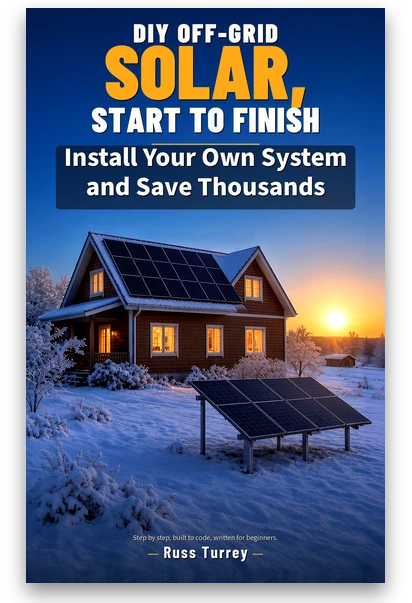
New book:
DIY Off-Grid Solar, Start to Finish.
Off-grid only, written for beginners who want to do the work carefully.
Kindle, $4.99 through New Year's: instant digital download. Paperback, $29.99: 370+ pages, 120+ diagrams, full-size 8.5 x 11 printed copy.