 Batteries
 Inverters
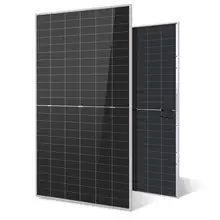 Solar Panels
 Solar Kits
 Mounting & Hardware
 Components & Wiring

Short answer: A solar panel spec sheet lists the numbers you need to match a panel to your inverter or charge controller. The key ones are rated power (Pmax), open circuit voltage (Voc), short circuit current (Isc), max power voltage and current (Vmp and Imp), and temperature coefficients. Voltage and current decide what the panel can safely connect to.
Key takeaways
- Every rating on the front of the sheet is measured at STC: 1,000 W/m² of light with the cells at 25°C.
- Voc is the highest voltage the panel makes, and it climbs in cold weather. Use it to check your string against the inverter’s max input voltage.
- Isc is the highest current. Compare it with the max PV input current of each MPPT input.
- Vmp and Imp are where the panel actually works. They tell you whether a string lands inside the MPPT operating range.
- The NMOT or NOCT column is closer to real rooftop output than the STC column.
What does a solar panel spec sheet tell you?
It tells you how much power the panel makes under a fixed lab condition, how it behaves electrically, how heat changes its output, and how big and heavy it is. Most of the decisions you make when pairing equipment come from the electrical table.
To keep this concrete, we’ll walk through the SunGold SGN-440-SW5 datasheet. It’s a 440W all black N-type panel we carry, and its sheet is laid out the way most panel sheets are.

What do STC and NMOT mean on a solar panel spec sheet?
They’re the two test conditions the electrical numbers are measured under. STC is the headline rating. NMOT is a gentler, more realistic condition, so the numbers are lower.
- STC (Standard Test Conditions): 1,000 W/m² of light, 25°C cell temperature, AM1.5 spectrum. This is where the “440W” comes from.
- NMOT (Nominal Module Operating Temperature): 800 W/m² of light, 20°C air temperature, 1 m/s of wind. Older sheets call a similar test NOCT.
Panels in the sun run much hotter than 25°C. PVEducation explains that modules typically operate at higher temperatures in the field than the 25°C rating, which is why NOCT and NMOT exist. On the SGN-440-SW5 sheet, the same panel that’s rated 440W at STC is listed at 328W at NMOT. Neither number is wrong. They just answer different questions.
How do you read the electrical ratings?
Read them as pairs: the maximum values (Voc and Isc) are for safety and equipment limits, and the working values (Vmp and Imp) are for performance. Here’s the SGN-440-SW5 electrical table:
| Spec | What it means | STC | NMOT |
|---|---|---|---|
| Pmax (Pmp) | Rated power | 440W | 328W |
| Voc | Open circuit voltage, the highest voltage with nothing connected | 39.03V | 36.84V |
| Isc | Short circuit current, the highest current the panel can push | 13.73A | 11.09A |
| Vmp | Voltage at maximum power | 33.48V | 31.34V |
| Imp | Current at maximum power | 13.15A | 10.46A |
A quick sanity check: Vmp × Imp should land close to Pmax. Here, 33.48V × 13.15A works out to about 440W. If a sheet’s numbers don’t multiply out, ask questions.
You’ll also see module efficiency (22.5% here), power tolerance (0 to +5W, so the panel shouldn’t test below its label), maximum system voltage (1500V) and maximum series fuse rating (25A).
Why do the temperature coefficients matter?
Because panel output changes with heat, and the coefficients tell you by how much. Each one is a percent change per degree Celsius (or Kelvin, same step size) away from 25°C.
- Pmax: -0.29%/K. Power drops as the cells get hotter. At 45°C cell temperature, that’s 20 degrees over STC, or roughly 5.8% less power.
- Voc: -0.28%/K. Voltage falls in heat and rises in cold. This is the one that can damage equipment.
- Isc: +0.04%/K. Current creeps up slightly with heat.
Here’s why Voc matters so much. On a -10°C winter morning, the cells are 35 degrees below STC. 35 × 0.28% is about 9.8%, so each panel’s Voc rises from 39.03V to about 42.9V. Ten panels in series would go from about 390V to about 429V. Your string has to stay under the inverter’s maximum PV input voltage at your coldest expected temperature, and the National Electrical Code has its own rules for that calculation, so your installer or inspector will confirm the final count.

How do you match a panel’s specs to an inverter or charge controller?
Line up four numbers from the panel sheet against four from the inverter or controller sheet. If all four fit, the pairing works electrically.
- Cold Voc × panels in series must stay under the max PV input voltage.
- Vmp × panels in series should sit inside the MPPT operating voltage range, on hot days too.
- Isc × strings in parallel must stay under the max short circuit current per MPPT input.
- Total panel watts should fit the inverter’s PV input rating.
That’s also why the charge controller type matters. Our MPPT vs PWM charge controller guide explains how an MPPT controller can take higher string voltage and convert it down for the battery.
What else is on the spec sheet?
The mechanical side matters for mounting, shipping and how many panels fit your space:
- Dimensions and weight: 67.80 x 44.65 x 1.38 in and 46.30 lb for this panel.
- Load ratings: 5400 Pa front (snow) and 2400 Pa rear (wind uplift).
- Cell count and type: 108 half cells, N-type monocrystalline.
- Certifications: UL 61730 (certified by ETL) and CEC listed.
- Warranty: up to 12 years of product warranty and a 30 year linear power warranty on this model.
If you’re comparing two panels side by side, our SGN-450-BDG5 vs SGN-440-SW5 comparison shows how small spec differences change string sizing. For the bigger picture, read how to choose solar panels for a home, see the SGN-440-SW5 product page, or browse all our solar panels.
Wondering what a cell count like 2×54 means? Our guide to half cut solar panels explains how split cell layouts work.
Frequently asked questions
What is the most important number on a solar panel spec sheet?
For safety, it’s Voc, because it sets how many panels you can put in series without going over your inverter’s voltage limit, especially in cold weather. For energy, Pmax tells you the rated output. Most buyers look only at watts, but Voc and Isc decide which equipment the panel can actually connect to.
What is the difference between Voc and Vmp?
Voc is the voltage the panel makes with no load connected, which is its highest voltage. Vmp is the voltage where the panel produces its maximum power while working. Use Voc to check equipment voltage limits and Vmp to check that a string falls inside your inverter or charge controller’s MPPT range.
Why is the NMOT rating lower than the STC rating?
NMOT uses less light, 800 W/m² instead of 1,000 W/m², and lets the panel heat up to a realistic operating temperature. Less light and more heat both reduce output. The NMOT number gives a better feel for everyday output, while STC is the standard used to label and compare panels.
What does a temperature coefficient of -0.29%/K mean?
It means the panel loses about 0.29% of its rated power for every degree Celsius its cells run above 25°C, and gains a little when colder. A lower number, closer to zero, means the panel handles heat better. It’s worth comparing between panels if you live somewhere with long, hot summers.
New book:
DIY Off-Grid Solar, Start to Finish.
Off-grid only, written for beginners who want to do the work carefully.
Kindle, $4.99 through New Year's: instant digital download. Paperback, $29.99: 370+ pages, 120+ diagrams, full-size 8.5 x 11 printed copy.