 Batteries
 Inverters
 Solar Panels
 Solar Kits
 Mounting & Hardware
 Components & Wiring


Short answer: Half cut solar panels use standard silicon cells sliced in two, so each piece carries half the current. Less current means less power lost as heat in the thin metal ribbons that connect the cells. The panel is also wired as two halves, which helps it keep producing when part of it is shaded.
Key takeaways
- A half cut panel has twice as many cells as a full cell panel of the same size, so 120 or 144 cells instead of 60 or 72.
- Halving the current cuts the resistive loss in the cell ribbons to about one quarter.
- Most half cut panels are split into an upper and lower section wired in parallel, which helps with partial shade.
- Voltage and current stay close to a comparable full cell panel, so system design works the same way.
- Cell count on a spec sheet, written like “2×54” or “108 cells,” is the quickest way to spot one.
What are half cut solar panels?
They’re panels built from solar cells that were cut in half, usually with a laser, before assembly. A standard square cell becomes two rectangular half cells.
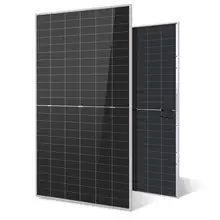
You’ll also see them called half cell, half cut cell or split cell modules. They all mean the same thing. If you look closely at the panel, you can often see a gap running across the middle where the two halves meet, with the junction box sitting near that line on the back.
Many panels sold today use this layout, including mono black, bifacial and N type models. It isn’t a separate category of panel. It’s a construction method that shows up across most modern product lines.
Why do manufacturers cut solar cells in half?
To cut electrical losses. Every cell sends its current through thin metal ribbons, and those ribbons have a little resistance. The power lost there rises with the square of the current, so halving the current drops that loss to roughly a quarter.
Researchers at Fraunhofer CSP explain this in their overview of half cell solar modules. They note that, depending on the cell type, ribbon losses can add up to about 3% of a module’s power, and cutting the cells reduces that to about 0.75%.
There’s a small trade off. Cutting creates a new cell edge, and the same paper puts the extra loss at the cell level at roughly 0.5% relative. The gain at the module level more than makes up for it, which is why the design spread so quickly.
How does a half cut panel handle shade?
Usually better than a full cell panel, but it depends on where the shade falls. In the most common layout, the panel is split into a top half and a bottom half that run in parallel, each protected by bypass diodes.
So if a vent pipe or a strip of snow covers part of the bottom half, the top half can keep producing. On a full cell panel, the same shade can switch off a whole substring through its bypass diode.
Fraunhofer’s paper is clear that this shade tolerance depends on the direction of the shade and the panel’s orientation. It helps with things like dirt collecting along one edge. It won’t rescue a panel that sits in heavy shade for half the day, so panel placement still matters most.

Half cut vs full cell solar panels: what’s different?
The main differences are cell count, internal wiring and how the panel behaves in partial shade. Electrically, the outputs you design around look much the same.
| Full cell panel | Half cut panel | |
|---|---|---|
| Typical cell count | 60 or 72 | 120 or 144 (same silicon, cut in two) |
| Current per cell | Full | About half |
| Ribbon resistive loss | Baseline | About one quarter of baseline |
| Internal layout | Substrings in series | Usually two halves wired in parallel |
| Partial shade | A shaded cell can bypass a full substring | The unshaded half can keep working |
| Panel voltage and current | Normal for its size | Similar to a comparable full cell panel |
That last row matters when you plan a system. The parallel wiring inside the panel brings the voltage and current back to familiar levels, so you size strings and charge controllers from the spec sheet numbers the same way you always would.
How can you tell if a panel uses half cut cells?
Check the cell count on the spec sheet. A half cut panel lists double the usual number, often written as two groups.
For example, SunGold’s datasheet for the SunGold SGN-440-SW5 440W mono black panel lists 108 cells, shown as 2×54, with a junction box that holds 3 diodes. That “2×” notation is the giveaway. Our guide on how to read a solar panel spec sheet walks through the rest of the numbers, from Voc and Isc to temperature coefficients.
A quick visual check works too. Look at the front of the panel for a horizontal gap across the middle, where the two halves of the cell matrix meet.
Are half cut solar panels worth it?
For most buyers it isn’t really a choice anymore. Half cut construction is standard on a large share of current panels, so you’ll get it without paying extra or hunting for it.
What matters more is comparing the things that actually change your output and lifespan:
- Wattage and efficiency for the space you have.
- Cell type, such as N type, and whether the panel is monocrystalline or bifacial.
- Temperature coefficient, which tells you how much output drops on hot days.
- Warranty terms for both the product and its power output.
- Physical size and weight, which affect racking and handling.
If you’re torn between two specific SunGold models, our SGN-450-BDG5 vs SGN-440-SW5 comparison lays out the bifacial versus mono black trade offs side by side.
Do half cut cells have any downsides?
A few, and they mostly sit with the manufacturer. Cutting the cells is an extra step, and it has to be done carefully.
The Fraunhofer researchers point out that the mechanical strength of the half cells after cutting is the key quality issue. Poorly cut cells can be weaker at the edge, which matters under wind and snow loads. That’s one more reason to buy from established brands with clear load ratings and solid warranties, rather than picking a panel on price alone.
When you’re ready to compare options, browse our individual solar panels and check each spec sheet for cell count, load ratings and warranty.
Frequently asked questions
Do half cut solar panels produce more power?
They lose less power inside the panel, so a half cut design can deliver more output than the same cells in a full cell layout. Cutting the cells halves the current, which drops resistive loss in the cell ribbons to about a quarter. The rated wattage on the spec sheet already includes this, so compare panels by their listed watts.
Are half cut solar panels better in shade?
Usually, yes. Most half cut panels are wired as a top half and a bottom half in parallel, so shade on one half doesn’t stop the other from producing. How much this helps depends on where the shade falls and how the panel is oriented. It won’t make up for a spot that sits in heavy shade.
Is a 120 cell panel the same as a 60 cell panel?
In size and silicon, roughly yes. A 120 half cell panel uses the same amount of cell area as a 60 cell panel, just with each cell cut in two. Its internal wiring is arranged so the voltage and current end up similar to a comparable full cell panel, so system sizing works the same way.
Can I mix half cut and full cell panels?
It’s best to avoid mixing panels in the same string. Panels with different voltage or current ratings drag each other down when wired together. The cell layout itself isn’t the issue. Mismatched electrical specs are. If you must combine panels, match their Vmp and Imp closely or put them on separate charge controller inputs.
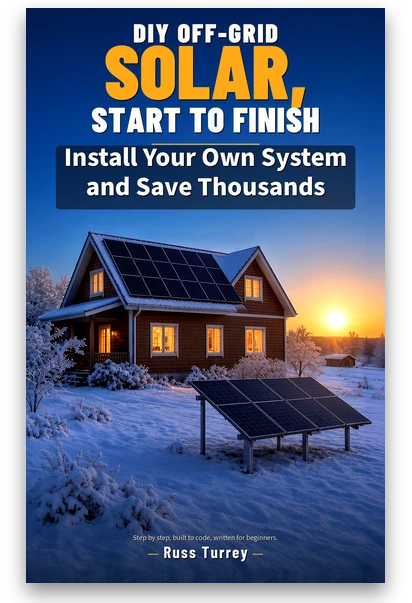
New book:
DIY Off-Grid Solar, Start to Finish.
Off-grid only, written for beginners who want to do the work carefully.
Kindle, $4.99 through New Year's: instant digital download. Paperback, $29.99: 370+ pages, 120+ diagrams, full-size 8.5 x 11 printed copy.